AI Video Analytics in Oman:
What to Validate Before You Deploy
A practical guide to where video analytics fits, what it needs from existing camera infrastructure, and how to scope a useful proof of concept.
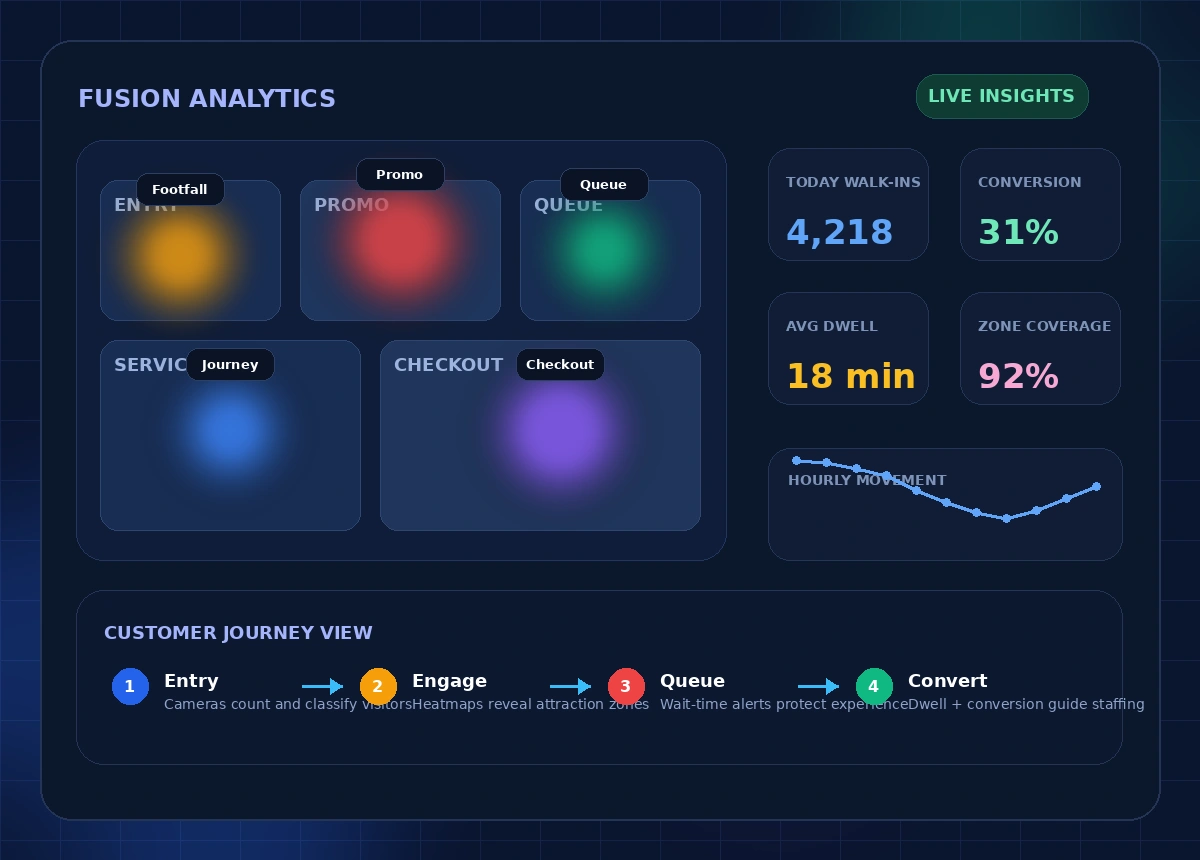
AI video analytics uses computer vision to turn suitable camera feeds into structured events and operational information. Instead of asking a team to watch every stream continuously, the system can be configured around specific questions: how many people entered a zone, when an area became crowded, whether a monitored boundary was crossed, or how activity changed by time and location.
The useful question is not whether a camera can run AI. It is whether the available view, image quality, processing design and workflow can produce information that someone can act on. That is why a focused proof of concept is usually a better starting point than a large rollout.
Where video analytics fits
The same computer-vision foundation can support different operational goals. In retail and malls it can support footfall, zone activity and customer-journey analysis. In security environments it can support monitored zones and event verification. In workforce use cases it can contribute attendance or presence events where the camera and workflow are suitable. Industrial and facility teams may use camera events as one input alongside asset, access, maintenance or building-system data.
These are different problems, even when they use similar technology. A good scope starts with one or two decisions the customer wants to improve, then works backward to the data required.
Can existing CCTV be used?
Often, suitable existing cameras can be part of the design, but suitability needs to be validated rather than assumed. Camera position, field of view, resolution, lighting, frame rate, network availability and the number of simultaneous streams all affect the result. A camera placed for general security coverage may not be ideal for accurate counting or detailed zone analytics.
Before changing hardware, test the actual feed against the intended use case. That avoids replacing cameras unnecessarily and also identifies the cases where a different angle or dedicated camera is justified.
What should a proof of concept validate?
1. A measurable use case
Define the event, metric or workflow that matters and how success will be judged.
2. Camera suitability
Validate the real feeds, angles, lighting and coverage rather than relying only on specification sheets.
3. Processing and integration
Confirm where inference runs, how events move, and which dashboard or business system receives them.
4. Operational response
Decide who uses the output, what action follows an event and which false positives are acceptable.
How to measure value
A useful measurement plan is tied to the original operational question. For customer analytics, that might mean consistent counts by entrance or zone. For security, it might mean the proportion of alerts that require analyst attention and the time needed to review them. For workforce or facility workflows, it may be the completeness and timeliness of events passed into the next system.
Avoid measuring the proof of concept only by whether the model produced detections. The important test is whether the information is accurate enough, timely enough and easy enough to use in the real operating process.
Deployment considerations
The final architecture should account for network capacity, retention, access controls, system ownership and the applicable privacy and security requirements for the organisation. It should also define how models, cameras and integrations are monitored after go-live so performance issues are visible.
For organisations evaluating AI video analytics in Oman, the fastest path to a useful answer is usually a narrow scope using real camera feeds, a clearly defined success measure and the people who will actually use the output.
Planning a video-analytics use case?
Nexura can review the use case, available camera environment, required outputs and the most practical PoC scope.
Discuss your requirement →AI video analytics — quick answers
Does AI video analytics always need new cameras?
No. Suitable existing camera feeds can often be evaluated first. The required view, image quality and use case determine whether changes are needed.
What should be tested first?
Start with a measurable use case, real camera feeds, a defined success criterion and the workflow that will consume the result.
Is a PoC useful before full deployment?
Yes. A focused PoC can validate camera suitability, processing, integration and operational value before a larger rollout.